
By the FlexPak Editorial Team
Pouch leak detection comes down to one question before any equipment gets involved: what is inside the pouch? A stand-up pouch of chips with a nitrogen headspace, a vacuum pouch of cheese, and a spouted pouch of sauce all leak, but they need different setups to show you where. Pick the wrong one and a leaking pouch can pass.
The chart below matches each pouch type to the ASTM test that fits it and the FlexPak setup that runs it.
Which leak test fits your pouch?
For most pouches the right test is ASTM D3078 bubble emission in a vacuum chamber, and the only thing that changes is whether the pouch needs help creating a headspace first. D3078 works by pulling a vacuum around a pouch held underwater, so gas inside the pouch pushes out through any breach and shows up as a steady stream of bubbles from one point. That stream tells you the leak exists and exactly where it is. A pouch with a gas headspace runs the test as is. A pouch with little or no gas inside, because it is vacuum packed or full of liquid, needs air admitted first, which is what the FlexPak VAC Attachment does. FlexPak builds vacuum chamber leak detectors that run all of these pouch tests for QA teams at food, co-packing and pharma plants, and ships them from Canada to plants worldwide.
| Your pouch | What is inside | Test that fits | FlexPak setup |
|---|---|---|---|
| Stand-up pouch, pillow pouch, flow wrap | Product plus air or a nitrogen flush | ASTM D3078 bubble emission | Leak detector chamber |
| Vacuum pouch, skin pack | Product with little or no gas | ASTM D3078 with air admitted first | Chamber plus VAC Attachment |
| Liquid pouch, spouted pouch, condiment sachet | Liquid, little headspace | ASTM D3078 with air admitted first | Chamber plus VAC Attachment |
| Sachets and stick packs in volume | Powder, granules or liquid in single-serve packs | ASTM D3078 on many packs per run | Chamber plus Stick Pack / Sachet Fixture |
| Retort pouch | Shelf-stable food after thermal processing | ASTM D3078 after the retort cycle | Chamber, see our retort pouch leak testing guide |
| Tyvek or medical pouch | Sterile device, porous material | ASTM F2096 internal pressurization | FPIPA add-on |
- A gas headspace is what makes a bubble test work on a pouch.
- No headspace means the VAC Attachment admits air before the vacuum is drawn.
- Porous medical pouches run a different method, F2096, because the material itself passes air.
- Every row above runs on the same FlexPak chamber with the add-on swapped.
Why a vacuum pouch can pass a bubble test and still leak
A vacuum pouch passes a bubble test it should fail for a simple reason: there is no gas inside to make a bubble. ASTM D3078 says so directly. The standard states that packaging with little or no headspace cannot be reliably evaluated by the method (ASTM D3078-02, reapproved 2013).
So a clean result on a vacuum-packed pouch, run without anything to add air, is not a pass. It is a test that could not have failed. That matters more than it sounds, because vacuum pouches are exactly where the product tends to be high value: cheese, fresh meat, coffee.
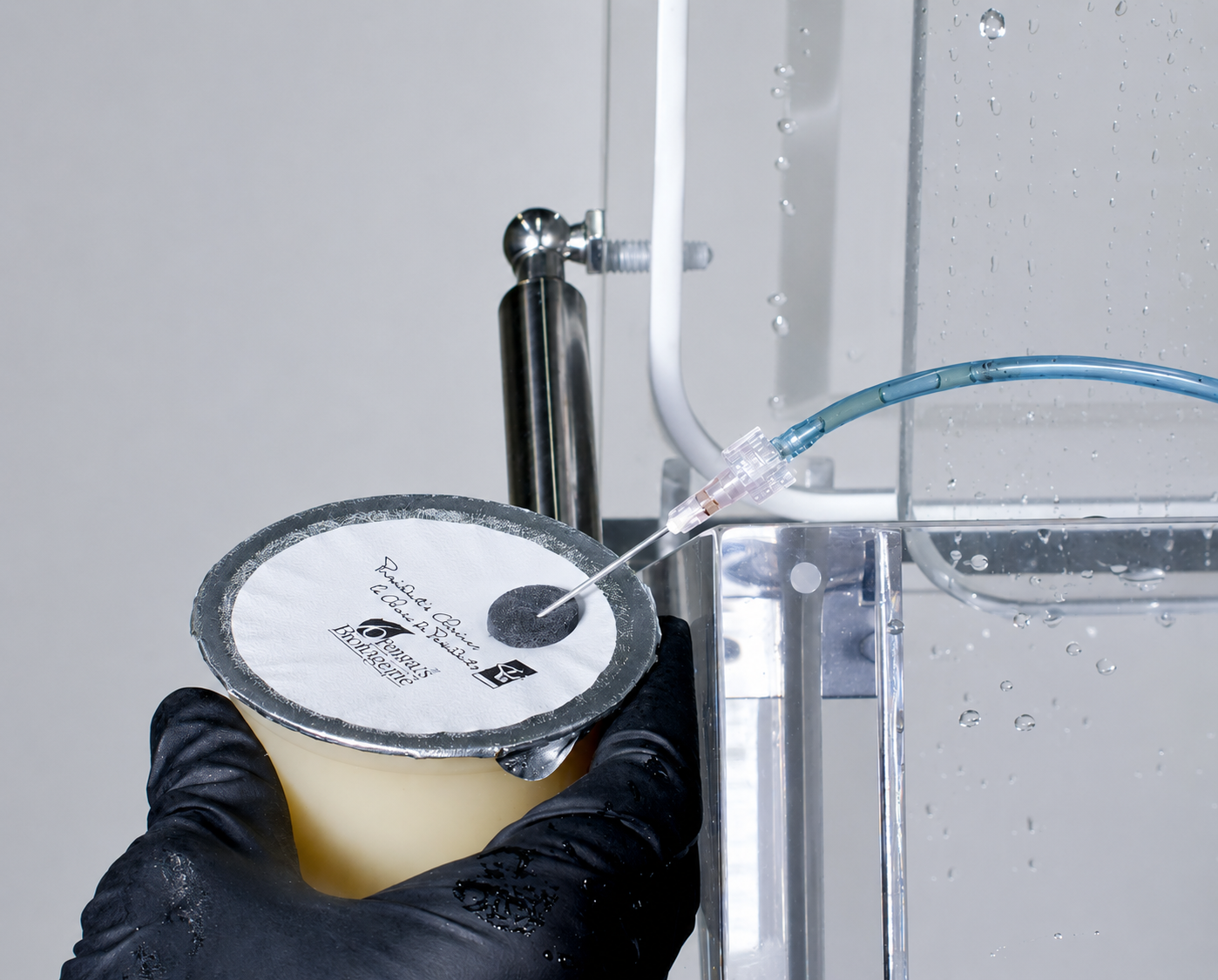
The VAC Attachment fixes this by injecting a shot of air through a septum patch on the pouch before the chamber is drawn down. Now there is gas to push out through a breach, and the test means something again.
How to run a pouch leak test in a vacuum chamber
A pouch leak test under ASTM D3078 takes a few minutes of setup and about 30 seconds of watching. Here is the sequence the standard lays out, in plain terms, with the FlexPak controls where they apply.
- Pick the fluid. Water works. Water with a wetting agent, denatured alcohol or mineral oil are also allowed by D3078, and a lower surface tension fluid shows smaller leaks.
- Add air if the pouch needs it. Vacuum, skin and liquid pouches get a shot of air through a septum patch using the VAC Attachment. Pouches with a normal headspace skip this step.
- Submerge the pouch. Keep it under so at least one inch of fluid covers it, the depth D3078 calls for.
- Draw the vacuum. Raise it at about one inch of mercury per second to the highest level the pouch tolerates without bursting. Higher vacuum finds smaller leaks. On an FPSA-T or FPFA-T controller this is one tap on a saved recipe.
- Hold and watch. D3078 recommends holding for about 30 seconds. A steady stream of bubbles from one point is a leak, and that point is your leak location. A few bubbles that float off the outside of the film and stop are trapped air, not a leak.
- Release and check inside. Let the vacuum down, take the pouch out and look for fluid that got in. Ingress confirms a breach even when the bubble stream was hard to see.
That is the whole pouch leak detection routine. If you want the full walkthrough with photos, our bubble leak test guide covers each step in more depth, and the ASTM D3078 explainer covers what the standard does and does not claim.
Where stand-up pouches tend to leak
Stand-up pouch leaks show up at the seals and fitments, where the pouch was made. When you run the test, watch these first:
- The top seal, where product or dust caught in the jaws leaves a channel through the seal.
- The corners where the bottom gusset meets the side seals, the thickest and hardest spot to seal.
- Around a zipper or a spout fitment, where two different materials meet.
- Pinholes from handling or from sharp product inside, like nuts, pet kibble or coffee beans.
In pouch leak detection the bubble stream points to which of these it is, and that tells you whether to look at seal jaw temperature, the fill line, or the material.
Sachet and stick pack leak testing, many at a time
Sachets and stick packs are pouches too, just small ones, and testing them one at a time cannot keep up with a high-speed filling line. The FlexPak Stick Pack / Sachet Fixture holds dozens of single-serve packs in the chamber at once, so one D3078 run checks a whole sample instead of one pack.
Powder and granule sticks often trap enough air to run as is. Liquid sachets, like condiments or electrolyte drinks, have very little, so they get the same treatment as a vacuum pouch: air first, then the test. Where your real concern is liquid escaping a sealed sachet rather than finding the exact breach, a dry chamber test on the same FlexPak unit shows you product forced out under vacuum without any water in the tank.
Which FlexPak pouch leak tester setup do you need?
Every FlexPak pouch leak tester starts with the same package leak detector, a transparent vacuum chamber with a gauge and valves, sized for anything from 1 oz sterile sachets up to a 10 kg bag of pet food. From there, you add only what your pouches need:
- VAC Attachment if you run vacuum, skin or liquid pouches.
- Stick Pack / Sachet Fixture if you test single-serve packs in volume.
- A controller. The FPSA-T holds two vacuum setpoints, which suits a plant running one or two pouch formats. The FPFA-T stores up to 24 bubble test recipes and logs every run, which suits a co-packer with many formats or a team building a validation file.
- An electric vacuum pump only if the test bench has no compressed air.
If you are not sure which combination fits, send us your pouch dimensions and what goes inside. We will tell you the chamber size and add-ons, and you will have a quote within 24 hours. Request a quote here.
Not sure which setup
Tell us your pouch and we will name the setup.
Send the pouch size and what goes inside. You get the chamber, the add-ons and a quote within 24 hours.
What a pouch bubble test will not tell you
A bubble test is a leak test, and it is honest about its limits. D3078’s stated sensitivity is a leak rate of about 1 x 10⁻⁵ atm cc per second, or less sensitive, so the smallest leaks can get past it. In the standard’s own precision study, a very small helium leak was caught about 78 percent of the time at 24 inches of mercury (ASTM D3078-02, reapproved 2013). That is why the highest vacuum your pouch tolerates is the setting to use.
Two more things worth separating. First, be wary of anyone quoting a micron size for a vacuum chamber bubble test. The often-quoted 250 micron figure belongs to ASTM F2096, the internal pressurization method for porous medical packaging, where it carries an 81 percent detection probability (ASTM F2096-11). Second, a bubble test does not measure how strong a seal is. Peel strength is a separate question answered on a tensile tester under ASTM F88, and a seal can pass that and still leak. Our page on seal strength versus seal integrity explains the difference, and the seal integrity test methods page compares the options for pouch seal integrity testing side by side.
Pouch leak detection FAQ
How long does a pouch leak test take?
About 30 seconds of hold time once the chamber reaches vacuum, which is what ASTM D3078 recommends, plus the time to load and unload the pouch.
Is stand-up pouch leak testing different from testing a flat pouch?
The method is the same, ASTM D3078 in a vacuum chamber. What changes is where you look. A stand-up pouch has a gusseted bottom, and the corners where the gusset meets the side seals are the hardest part of the pouch to seal well, so watch those during the hold. Stand-up pouches with a nitrogen flush already have the headspace the test needs. Stand-up pouches packed tight to the product, like vacuum coffee, need air admitted first.
Can you leak test a pouch full of liquid?
Yes. A liquid pouch has little gas inside, so the VAC Attachment admits air through a septum patch before the vacuum is drawn, and the pouch then runs as a normal bubble emission test. If you only need to know whether liquid escapes, a dry chamber test on the same unit shows that without water in the tank.
Does a pouch leak test destroy the pouch?
Treat tested pouches as samples, not stock. A pouch that has been submerged and taken to high vacuum, or punctured for the VAC Attachment, should not go back on the line, so plan your sample size around that. That is normal for bubble emission testing, and it is why the pouch count per sample matters more than the test time when you set up a QA routine. Your auditor or customer specification usually sets the sampling plan, and the FPFA-T’s run log gives you the record to show them.
What is the best pouch leak testing machine for a small plant?
For one or two pouch formats, a tabletop FlexPak chamber with the FPSA-T controller covers it. Add the VAC Attachment only if your pouches are vacuum packed or liquid filled.